Masonry Work That Holds Up Across Greater Boston
Mortar turning to sand between the bricks, a stone that shifts when you lean on it, a crack working its way up the corner of the house. On the older homes across Greater Boston, brick and stone were laid by hand a century ago, and decades of freeze-thaw winters, road salt, and settling eventually work them loose. Caught early, it’s a repair. Left alone, it’s a rebuild.
Three Hills Masonry & Foundations provides masonry services across Greater Boston, from brick and stone repair to repointing, restoration, and rebuilding failed sections. We do it as masons, not a landscape crew that sets stone for the season and moves on, which means the work is matched to the original brick and built to carry weight and shed water for decades. Every job starts the same way: we come out, find what’s actually going on, and give you a straight answer on what it needs and what it costs. No pressure, no runaround.
Not Sure What Your Masonry Needs?
We come out, look at the brick and stone, and give you a straight read on what it needs. The estimate is free.
What Do Masonry Services Actually Cover?
Masonry is any structure built from individual units, brick, stone, block, or concrete, set and bound with mortar. On a house, that runs from exterior walls and facades to foundations, chimneys, steps, and walkways. Masonry services cover both sides of it: repairing and restoring what’s already there, and building new brick and stone from scratch.
Most masonry repairs start with one question: why is it failing? Usually it’s water in the masonry, freeze-thaw widening the gaps, or a base that has settled, and the fix follows from there, repointing failed joints, replacing spalled brick, resetting loose sections, or sealing the wall.
Done right, masonry isn’t patched over, it’s matched to the original and built to carry weight and shed water for decades.
The Masonry Work We Handle Across Greater Boston
Most of what we do falls into a handful of core masonry services. Some homes need just one, others need a few at once, since the same water and freeze-thaw that crack a brick wall tend to go after the chimney, steps, and foundation too.
Brick & Stone Repair
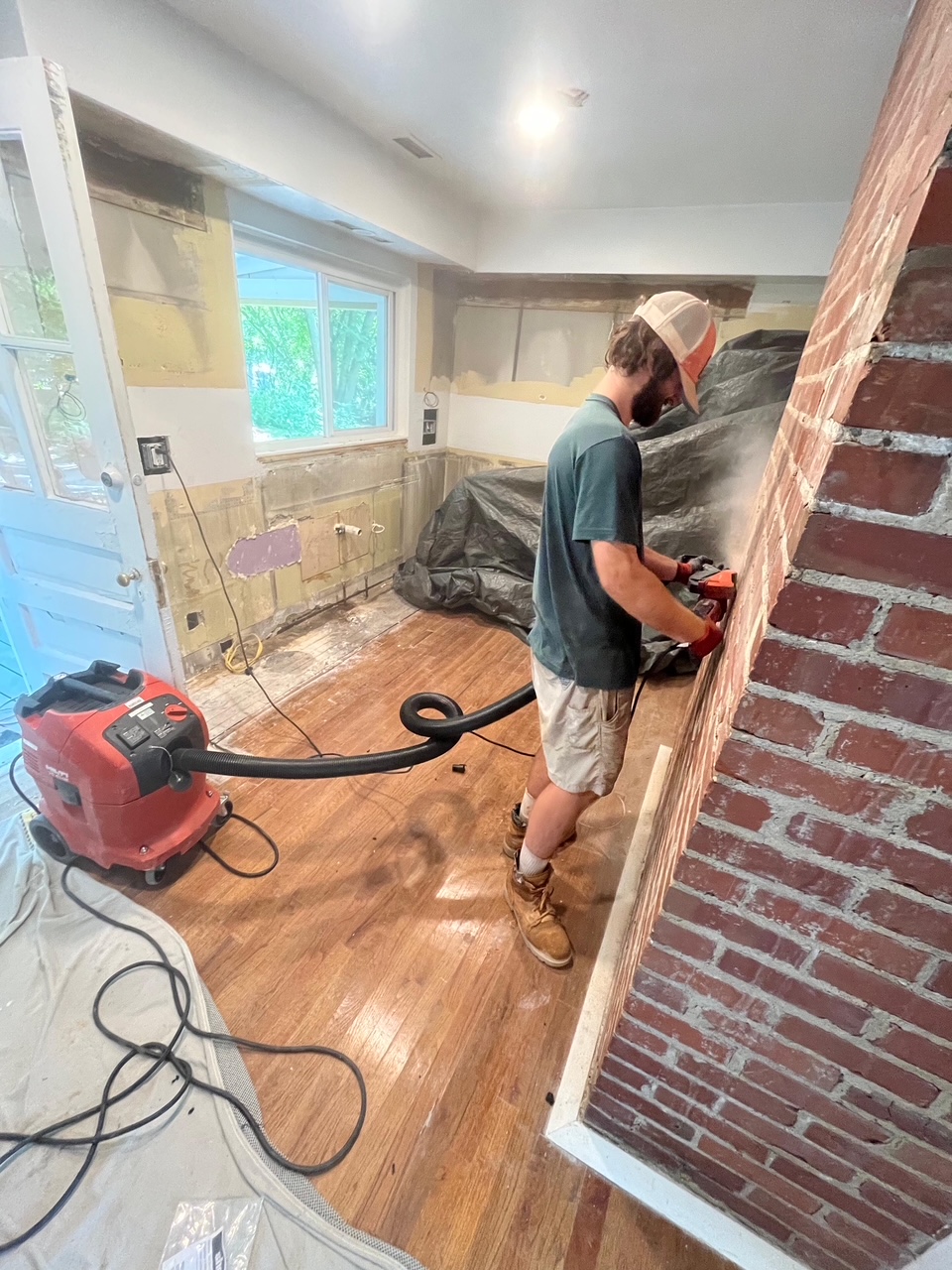
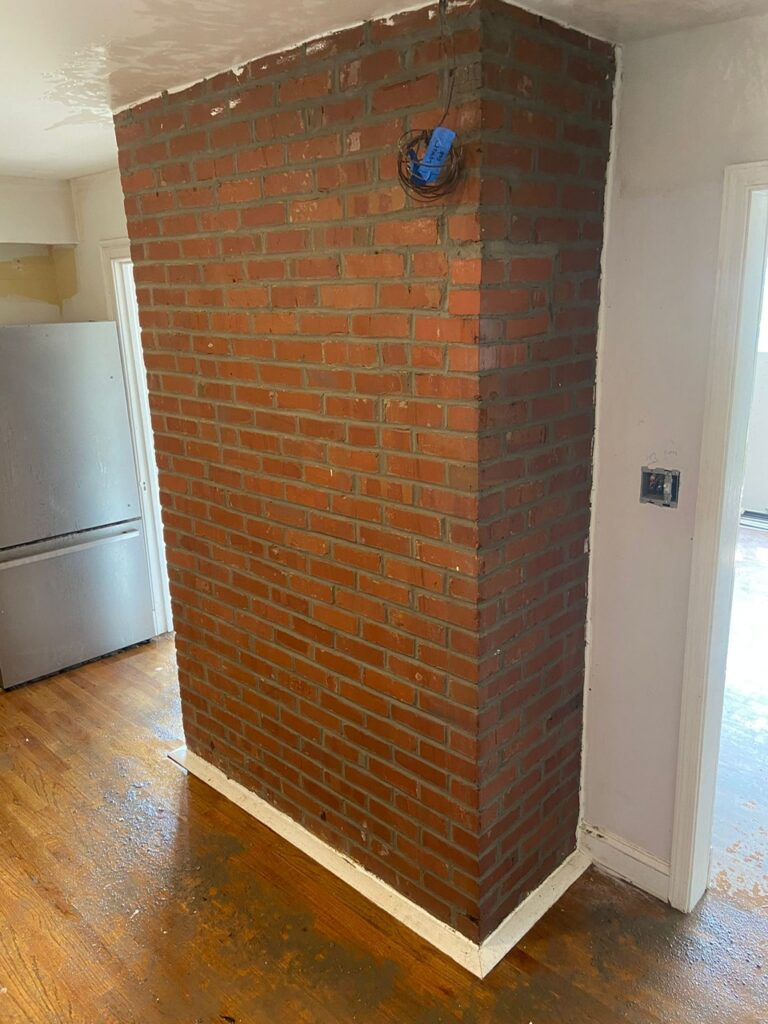
Cracked, loose, or spalled brick and stone get cut out and reset or replaced, matched to the original so the wall reads as one piece. This is the heart of residential masonry repair, the same hands-on work that resets a wobbling tread on a set of front steps or brings a tired facade back. It is usually where a failing wall, pier, or facade first shows itself.
Repointing & Tuckpointing
When the mortar joints turn to sand or wash out, water runs straight into the wall and the brick loses its grip. Brick repointing, also called tuckpointing, cuts out the failed mortar and packs the joints with fresh, matched mortar. It is the single most common fix on older brick and stone, and the same repair a brick chimney needs when its joints wash out up top.
Masonry Restoration
Restoration is the larger job of bringing worn or historic masonry back to sound condition, usually combining repointing, brick and stone replacement, parging, and sealing the masonry so it stops taking on water, the same goal behind foundation waterproofing. On the older homes across Greater Boston, historic masonry restoration is as much about matching the original brick, stone, and fieldstone as it is about repairing it.
Rebuilding & Resetting Failed Sections
When a section has shifted, bowed, or pulled loose, resetting or rebuilding puts the wall back the way it was built, on a base corrected to carry the load. When that section is a foundation wall, the principle is the same: fix what is moving underneath before resetting the stone on top. Done in time, it is what keeps a partial failure from spreading into a full foundation repair.
New Brick & Stone Construction
Beyond repair, we build new brick and stone from the ground up, set on a proper base and built to carry weight and shed water the way masonry on a well-built older home still does a century later. That includes new brickwork and stonework matched to your home, right down to a fresh walkway leading up to the door.
New build or old repair, it comes back to the same handful of things: finding the cause, matching the material, and building the fix to last. Here is what that actually gets you.
Catch It Early, Skip the Rebuild
What Solid Masonry Does for Your Home
Done right, masonry is the kind of work you stop thinking about. Here is what it gets you.
- Stops Small Problems Before They Turn Structural: A repointed joint or a reset stone today keeps a wall from bowing, a section from dropping, and a minor repair from becoming a full rebuild.
- Keeps Water Where It Belongs: Sound mortar and sealed masonry shut out the water that drives most brick and stone failure, along with the rot, mold, and movement that follow it.
- Protects Your Home’s Value: Brick and stone are the first thing a buyer or home inspector looks at, and sound, documented masonry clears a red flag before it ever comes up.
- Blends Into the Original Masonry: Matched to the original brick, stone, and mortar, the repair disappears into the wall instead of reading as a fresh patch, which matters most on older homes.
- Built to Hold for Decades: Set on a proper base with the right materials, masonry holds up the way it always has on a well-built home.
None of those benefits come from the surface you can see. They come from the material underneath the finish and the base under that, the parts a homeowner never notices until something starts to crack or shift. Which is why the right material, and the right call between a repair and a rebuild, is what decides how long any of it actually holds.
Brick, Stone, Fieldstone, or Concrete?
Most masonry on a Greater Boston home is built from one of a few materials, and the right approach depends on which one you have. Brick, natural stone, fieldstone, concrete block, and poured concrete each age differently and call for different repairs, so knowing what your house is built from is the first step in knowing what the work will take.
On the older homes common across the area, the material usually picks itself, because the job is matching what is already there. New mortar has to be mixed softer than the brick or stone so the masonry can move without spalling, and replacement units have to match the original in color, size, and texture so the repair blends in. That is the difference between brick masonry, stone masonry, and fieldstone work that disappears into the wall and a patch that stands out for years.
| Material | What Stands Out | Common On |
|---|---|---|
| Brick | Classic New England look, repaired or repointed one unit at a time | Facades, chimneys, exterior walls, steps |
| Natural Stone | Dense and durable, lasts for generations with the right mortar | Walls, piers, steps, accents, older foundations |
| Fieldstone | Irregular, hand-laid stone with wide joints that need careful matching | Foundations and walls on older homes |
| Concrete Block | Structural and economical, often parged or faced to finish | Foundation walls and structural sections |
| Poured Concrete | Solid and continuous, sealed against water once cured | Foundations, slabs, and steps |
On a new build, the material comes down to the look you want and what holds up best for the job and the budget. On an older home, it comes down to matching the original, which is where real experience with brick, stone, and fieldstone earns its keep.
How a Masonry Project Goes, Start to Finish
Hiring someone to work on your brick and stone shouldn’t feel like a gamble. Every masonry project runs the same straightforward way, and the crew that prices the work is the crew that does it, not a salesman out front and a subcontractor you have never met behind him.
- Reach Out: Call or send a few details and photos of what you are seeing, and we get you on the schedule for a look.
- On-Site Estimate: We come out, inspect the brick and stone in person, pin down what is actually causing the problem, and hand you a clear written price. The visit is free.
- Schedule the Work: Approve the estimate and we lock in a date that fits your calendar, not just ours.
- Build It and Clean Up: Our crew handles the masonry work from start to finish, keeps you posted as it goes, and leaves your property clean when it is done.
Same crew start to finish, a price you approve before we begin, and masonry built to stand up to the next round of New England winters. No surprise number at the end, no runaround.
Why Greater Boston Homeowners Choose Three Hills for Masonry
Most masonry work in Greater Boston goes to one of two kinds of company: a landscaper or hardscaper who sets stone for the season and moves on, or a general contractor who patches the obvious problem and calls it done. Three Hills Masonry & Foundations is a masonry company first, which means we treat brick and stone as what it is, a structure that has to carry weight and shed water for decades, not a surface to cover over. The owner grew up in the trade and runs his own crew on every job, so the person who quotes your masonry is the one who stands behind the work.
That work is backed by a 25-year guarantee, and Three Hills is a registered, insured Home Improvement Contractor (HIC #219738), with free estimates on every job. You get a clean site, a clear explanation at each step, and a straight answer on what your masonry needs and what it costs before any work begins. No pressure, no runaround.
Your Masonry Could Be the Next Job We Take On
Masonry Services Across Greater Boston
Wherever there’s brick, stone, or block in Greater Boston, there’s masonry to keep up, and Three Hills covers it across the city and the towns around it: Boston, Charlestown, Cambridge, Chelsea, Somerville, Allston, Quincy, Dedham, Norwood, Westwood, Canton, Randolph, Braintree, Weymouth, and Hingham. If you’re nearby and don’t see your town here, ask anyway, odds are good we work where you are.
FAQs about Masonry in Greater Boston
How much do masonry services cost?
There's no flat rate for masonry work. The cost depends on the material, the size and condition of what's being repaired or built, and how much of the structure is involved, so sealing a single joint and rebuilding a failed wall are worlds apart on price. The only honest number comes from a free on-site estimate.
Can masonry be repaired, or does it need to be rebuilt?
Usually it can be repaired. Most brick and stone only needs repointing, a few replaced units, or a reset section rather than a full rebuild. A rebuild comes into play only when the wall has structurally failed, started to lean, or lost too much material to stand on its own.
Do you handle new masonry as well as repairs?
Yes, both. Three Hills builds new brick and stone from the ground up and handles repair, repointing, and restoration on existing masonry, matching the original material on older homes so the work blends in.
What's the difference between masonry repair and restoration?
Repair fixes a specific problem, like repointing a failed joint or replacing a cracked brick. Restoration is the larger job of bringing worn or historic masonry back to sound condition, often combining repointing, replacement, parging, and sealing. Most jobs are repairs; restoration is for masonry that has gone too long without attention.
Will new masonry match the brick and stone on my older home?
Yes. Matching is a core part of the work: replacement brick and stone are chosen to match the original in color, size, and texture, and new mortar is mixed softer than the masonry so it holds without spalling. Done right, the repair disappears into the wall.
Are you licensed and insured?
Yes. Three Hills Masonry & Foundations is a registered, insured Home Improvement Contractor (HIC #219738), and every job is backed by a 25-year guarantee with free estimates.
How much do masonry services cost?
There’s no flat rate for masonry work. The cost depends on the material, the size and condition of what’s being repaired or built, and how much of the structure is involved, so sealing a single joint and rebuilding a failed wall are worlds apart on price. The only honest number comes from a free on-site estimate.
Can masonry be repaired, or does it need to be rebuilt?
Usually it can be repaired. Most brick and stone only needs repointing, a few replaced units, or a reset section rather than a full rebuild. A rebuild comes into play only when the wall has structurally failed, started to lean, or lost too much material to stand on its own.
Do you handle new masonry as well as repairs?
Yes, both. Three Hills builds new brick and stone from the ground up and handles repair, repointing, and restoration on existing masonry, matching the original material on older homes so the work blends in.
What’s the difference between masonry repair and restoration?
Repair fixes a specific problem, like repointing a failed joint or replacing a cracked brick. Restoration is the larger job of bringing worn or historic masonry back to sound condition, often combining repointing, replacement, parging, and sealing. Most jobs are repairs; restoration is for masonry that has gone too long without attention.
Will new masonry match the brick and stone on my older home?
Yes. Matching is a core part of the work: replacement brick and stone are chosen to match the original in color, size, and texture, and new mortar is mixed softer than the masonry so it holds without spalling. Done right, the repair disappears into the wall.
Are you licensed and insured?
Yes. Three Hills Masonry & Foundations is a registered, insured Home Improvement Contractor (HIC #219738), and every job is backed by a 25-year guarantee with free estimates.
Let’s Take a Look at Your Masonry
Brick and stone don’t fix themselves, and a New England winter only pushes a small problem toward a bigger one. The sooner you have it looked at, the smaller the job tends to be and the more options you have. A free on-site visit from Three Hills Masonry & Foundations tells you exactly what your masonry needs and what it costs, with no pressure to move forward. If something is cracking, shifting, or letting water in, let’s take a look before the next freeze gets to it.